Penulis :
Febrian Agil

Editor:
Refina Anjani Puspita

Editor:
Tsabita Prameswari

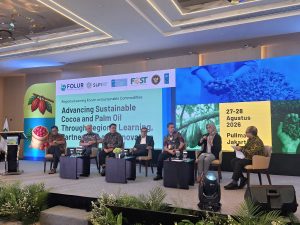
Jakarta, August 28th 2026 — Dr. Maharani Hapsari, Director of the Center for World Trade Studies, Universitas Gadjah Mada (CWTS UGM) and Chairholder of the WTO Chair Programme Indonesia, contributed as a panelist at the Regional Learning Forum on Sustainable Commodities: Advancing Sustainable Cacao and Palm Oil Through Regional Learning, Partnership, and Innovation, held in Jakarta on 27–28 August 2026. The regional forum was convened by UNDP Indonesia in collaboration with Indonesia’s Coordinating Ministry for Food Affairs, Coordinating Ministry for Economic Affairs, and Ministry of Agriculture, with support from the Global Environment Facility (GEF), Switzerland’s State Secretariat for Economic Affairs (SECO), and the United Kingdom’s Foreign, Commonwealth and Development Office (UK FCDO).
Over the two-day event, the forum brought together government representatives, development partners, the private sector, and stakeholders from Indonesia, Malaysia, and Papua New Guinea to exchange experiences and good practices in advancing sustainable cacao and palm oil value chains. The forum was structured around four panel dialogue sessions, complemented by a series of side events including an exhibition, business matchmaking, and a youth forum. Dr. Maharani Hapsari brought a trade and international market competitiveness perspective to Panel Dialogue Session 4, titled “Multistakeholder Dialogue: Strengthening Partnerships, Financing, and Innovation for Sustainable Palm Oil.” The session was the closing panel of the forum, held this past Friday (28/8).

Joining Dr. Maharani on the panel were Rashyid Redza Anwarudin (Chief Sustainability Officer, SD Guthrie Berhad), Jeffry Faizal Kamaruddin (CEO, Upstream Malaysia, SD Guthrie Berhad), Mohamad Fadhil Hasan (Head of Foreign Affairs, GAPKI), and Dr. Ir. Ismail Maskromo (Senior Researcher, Research Center for Plantation Crops, National Research and Innovation Agency). Session 4 examined how Indonesia, Malaysia, and Papua New Guinea can align their efforts to respond to increasingly complex market and sustainability requirements.
In her presentation, “Advancing Regional Collaborations for Sustainable Palm Oil,” Dr. Maharani framed regulations such as the European Union Deforestation Regulation (EUDR) and other emerging international market requirements as part of a broader process of global norm diffusion and the formation of collective leadership among producer countries. She noted that palm oil retains a structural advantage, with land productivity roughly four times higher than soybean, while Certified Sustainable Palm Oil (CSPO) now accounts for around 20 percent of global output, or approximately 16.2 million metric tons, with uptake exceeding 90 percent in major markets such as Europe and North America.
Even so, Dr. Maharani Hapsari cautioned that the global palm oil market risks splitting in two as EUDR standards take effect. Palm oil that meets the standard fetches a higher price, while non-compliant supply will be pushed toward markets outside the European Union, such as India, China, and several other countries across Asia and Africa. To illustrate the point, she compared the readiness of three producer countries. Indonesia has the world’s largest smallholder palm oil area and is working to secure EU recognition for its ISPO certification, but only around a fifth of smallholder land currently has verified data. Malaysia is further along, with more than half of its smallholder land already registered under MSPO certification. Papua New Guinea, despite its small output, stands to benefit because its plantations are easily traced and most of the country remains forested.

“Sustainability standards set by export destination countries must not end up pushing smallholders out of the more lucrative market. What we need is mutual recognition of certification schemes such as ISPO and MSPO, along with interoperable data systems. That way, sustainable palm oil won’t end up creating new market inequalities,” said Dr. Maharani Hapsari.
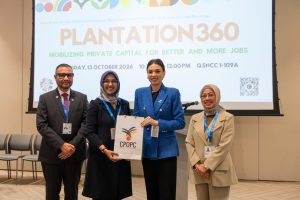
She also highlighted the role of the Council of Palm Oil Producing Countries (CPOPC), an organization of palm oil-producing countries that now represents nearly 89 percent of global palm oil production. Its member countries include some of the world’s largest palm oil producers, such as Indonesia, Malaysia, Papua New Guinea, Costa Rica, and Nigeria. Through CPOPC, producer countries negotiate directly with the European Union on EUDR and are pushing for sustainability financing to reach smallholders, not just large companies.
Smallholder welfare and gender equality featured prominently in Dr. Maharani’s presentation, ranging from the International Oil Palm Smallholder (IOPS) Forum initiative, which promotes a shared commitment among the world’s palm oil smallholders to nature-positive farming practices, to cross-regional Good Agricultural Practices training in Papua New Guinea and the Democratic Republic of the Congo, and proposals for certification schemes such as ISPO, MSPO, and RSPO to incorporate gender-sensitivity training, expanded land and financing access for women farmers, more inclusive workplace reforms, and systems to monitor gender equality outcomes across the supply chain.

Dr. Maharani’s participation in the forum builds on the Capacity Building Programme on Foreign Negotiation and Diplomacy in Sustainable Palm Oil Practices, which CWTS UGM has run with UNDP since April 2026 through the FAST Project, funded by the UK FCDO. The programme combines multistakeholder knowledge production, self-paced learning through a Learning Management System (LMS), blended training with policymakers, and field visits across the upstream-to-downstream palm oil supply chain. CWTS UGM’s involvement in this regional forum in Jakarta reflects its ongoing commitment to connecting evidence-based research with the broader palm oil diplomacy and policy landscape across the Asia-Pacific region.